

The Burnout Reportby

Southwest® has always been committed to giving everyone the best hospitality in the skies.
So, to better understand travelers, we asked 2,001 Americans what’s really going on. The answer was clear: everyone is burned out.
Through our research, we know what helps: taking real trips. The good news? We’re pretty good at helping you do just that.
TL;DR Too burned out to read the whole report? We get it. Here’s the main takeaway.
People aren’t taking enough time off to recharge. Southwest® wants you to take charge of the time you have and Enter Airplane Mode.
Boost your vacation planning.
Dream of somewhere you’ve never been with our over 100 destinations to choose from.
Make the most of your time.
It takes about 5 days to feel relief from burnout. With no change or cancel fees* you have the flexibility to add days to your trip.
Start vacation sooner.
As the LUV® Airline, we’re all about making the most of every step of the journey. Start that book or reunite with friends as soon as you arrive at the airport.
*Fare difference may apply. Basic fare roundtrip bookings must be canceled or upgraded. Cancel 10+ minutes before departure to avoid forfeiture of travel funds.

01. What We Know
America— we’re overdue for a break.America is burned out*. 76% of us, to be exact.
*Burnout is defined as a state of emotional, mental, and/or physical exhaustion caused by ongoing stress. This could be stress from a job and/or your personal life.
80% feel burned
out at least once
a month.
Somewhere along the way,
it’s become the norm.


As the LUV® Airline we wanted to help.
So we dug deeper and created this report to uncover why everyone’s burned out and what Southwest can do about it.
We went straight to the source.
2,001 Americans aged 18-64
answered questions like:
02. What We Found
There’s a disconnect. People know they should be taking trips, but aren’t taking the time off.
People can tell you exactly
how burned out they are.
Here’s the breakdown of the 76% of Americans currently experiencing burnout:
13% are totally burned out, 26% are noticeably burned out, 37% are starting to feel it.
There are good months, and
not-so-good months.
We asked people to select and rank the 3 months of the year when they typically feel the most stress and potential burnout in their life.
The good news? We know what helps.
From taking a nap, to taking a
trip (and yeah, even crying it
out), there are many ways to
take the edge off of burnout.
Here’s how people responded when asked how they find relief.
- 31%Regular exercise
- 26%Taking a nap
- 25%Watching TV
- 24%Spending time with family
- 22%Taking a 2+ day vacation
- 21%Playing games
One solution stood out to us: vacation. Southwest can help with that. We fly more air travelers nonstop within the United States than any other airline*.
Among people who have taken a 2+ night vacation:
*Based on U.S. Dept. of Transportation quarterly Airline Origin & Destination Survey as of Q4 2025.
The bad news? Most of us are bad at helping ourselves.
We’re not taking trips.
Over a third (34%) of Americans haven’t taken a 2+ day trip in over a year.

We’re not being
proactive.
Everyone is waiting until they feel burnout to (maybe) do something about it.
- 42%plan a vacation when they start to feel the burnout.
- 20%plan a vacation when they reach near or total burnout.
 62%factor in burnout when vacation planning.
We are leaving PTO days on the table…
Across 2025 and 2026, 3 in 4 people are failing to use all their vacation days.
Leaving us short of what we
actually need to feel relief.
36% of people are in a Vacation Gap.
03. The Solution
Enter Airplane Mode.
Planning your life? *Hides*
Planning for vacation? Let’s go!
We get it, planning a vacation is a lot of logistics, but think of ways to make it fun.
Find a destination (we fly to more than 100 for you to choose from) and gather inspiration: ask your friends about it, daydream about your travel fit, and go to a coffee shop to plan.
In the same way our pilots tell jokes and our flight attendants celebrate milestones midflight, we believe there’s always room to make every journey more fun. That’s the secret behind our hospitality. We genuinely enjoy making your trip the best it can be.
Give your relief enough runway.
You don’t need 2 weeks and an international destination to eliminate burnout. Turns out, people need about 5 days to feel relief.
There are plenty of great destinations around America. Don’t be afraid to add a day to explore a nearby city or decompress. Remember, with no change or cancel fees*, you can be flexible.
*Fare difference may apply. Basic fare roundtrip bookings must be canceled or upgraded. Cancel 10+ minutes before departure to avoid forfeiture of travel funds.

Treat travel as the beginning of the reset.
Vacation starts the minute you decide it does. The airport or the plane are great places to start the book you’ve been wanting to read, catch up on movies, and reconnect with the people you love.
This is your time, so take it.Somewhere along the way, we’ve begun to treat vacation as a reward that must be earned. Your time should be yours to take back.
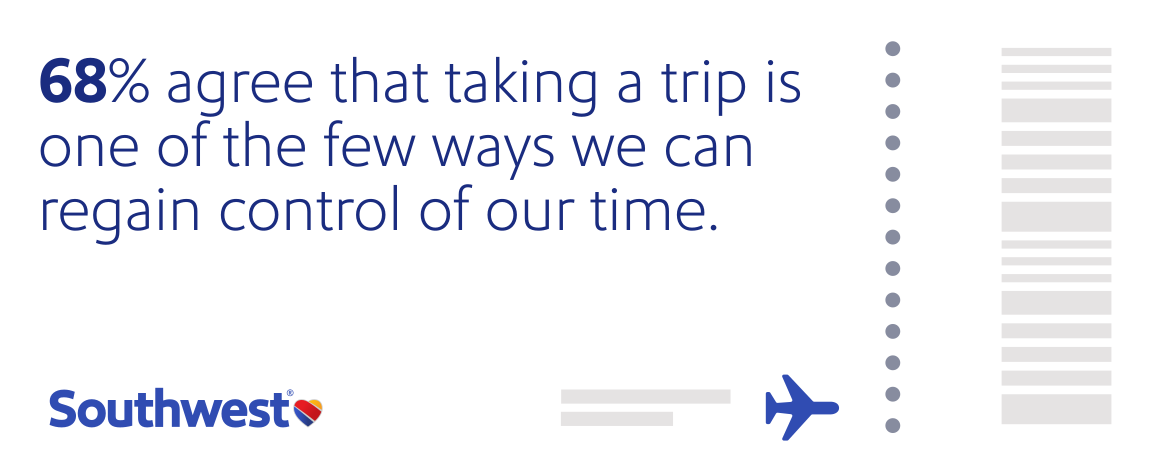
68% agree that taking a trip is one of the few ways we can regain control of our time.
Southwest isn’t just here to take you places. We’re committed to giving you the best hospitality every step of your journey. That includes empowering you to reclaim your time and make the most of it. It’s time to show burnout who’s boss.


Burnout FAQs
What is burnout?
According to the World Health Organization, Burnout is “a syndrome conceptualized as resulting from chronic workplace stress that has not been successfully managed.” And even though it certainly doesn’t feel great, the WHO notes that burnout is not classified as a medical condition.
What are the signs of burnout? The World Health Organization characterizes burnout in three ways:
- “Feelings of energy depletion or exhaustion
- Increased mental distance from one’s job, or feelings of negativism or cynicism related to one’s job
- Reduced professional efficacy”
Is burnout only about work?
If only work was the only thing to blame. Based on our results, we found burnout can be any emotional, mental, and/or physical exhaustion caused by stress in general. And we all know, life is stressful (professionally and personally).
Why is Southwest doing this research?
As America’s Hospitality Airline, we’re not just here to take you places, we’re here to help you reconnect with what matters most. We believe taking your time back matters. We conducted this research to better understand how burnout is affecting Americans, and what we can do about it.
What’s the difference between stress and burnout?
Stress is the body’s immediate, natural response to a threat, change, or challenge. In small doses, stress is actually thought to be helpful. Burnout, on the other hand, happens after prolonged periods of stress. And it’s anything but helpful. It can leave you feeling empty, emotionally drained, and unable to keep up with everyday life.
As the meditation app Calm puts it, “stress is like a battery running low, burnout is like the battery being completely flat.” Calm also outlines that stress tends to have physical symptoms, while burnout can manifest more deeply, impacting one’s emotional state.
How common is burnout in the US?
Americans have a reputation for working, A LOT. We’re an always-on, always optimizing culture that is 20% more stressed out than our Canadian counterparts. This can be for a variety of reasons, one of which is that the U.S. is one of the few countries that doesn’t have guaranteed paid time off annually. Hey, we don’t make the rules.
What percentage of Americans are burned out?
A lot of us. We found that over a third, 76% of Americans to be exact, have dealt with burnout.
Our Methodology: We surveyed 2,000 American adults aged 18–64 living in the U.S. Quotas for gender, age, and household income mirror U.S. census data. Sample targeting and data weighting were also used to more accurately represent ethnicity and U.S. census regions. Individuals in sensitivity industries (advertising, PR, marketing research, airline, travel agency) were excluded.
When was this research conducted?
The survey was fielded August 17–25, 2026.
What’s a vacation deficit?
A vacation deficit, as defined by our research, is the gap between the amount of time you typically take off and the amount of time you actually need to get some relief from stress or burnout.
We found that 36% of people who have taken a vacation of two or more nights were in a vacation deficit, falling short by an average of 2.9 days. In other words, many of us are taking time away, but not enough for our minds and bodies to fully reset.
Can travel really help with burnout?
We’re happy to say it absolutely can and does. While travel isn’t a cure-all for burnout, our research shows that a meaningful break from everyday demands can create space for rest and connection that allows people to regain a sense of control over their time.
The research found that 86% of people who have taken a vacation of 2+ nights say vacations are effective in relieving stress or burnout. Taking a vacation of 2+ nights was also one of the more highly-rated actions for dealing with burnout, second only to regular exercise when people ranked what felt most effective.
How much time off do I actually need?
Unfortunately, there isn’t a magic number. But among people who have taken a vacation of two or more nights, the average answer was about five consecutive days to get some relief from stress or burnout.
This does not mean that a shorter break has no value, but it does show that longer, uninterrupted time away may provide more relief. Adding even an extra day to a trip, building in time to decompress, or extending a long weekend can make all the difference.